

There's more to selling perfume than just the liquid inside a bottle; customers make purchases thinking about how the fragrance will make them feel, and the brands that are able to understand that capitalize on it. The fragrance industry has gone through a lot of changes in the last decade; now that TikTok is a main source for product discovery, customer loyalty has become harder to earn than ever before. In an industry that had over 6000 releases in 2025 alone, you need to be on top of your game to stand out.
Understanding the 2026 Perfume Market
The perfume market was valued at approximately USD 60 billion in 2025 and is projected to reach $96.1 billion by 2033, growing at roughly 6.1% annually. Just in the United States, the premium segment held about 61.3% of total revenue. This is why perfume sellers need to conduct market research frequently since industry trends evolve quickly.
Here's what's shaping the perfume industry right now:
-
Niche over mass: Buyers increasingly value uniqueness, ethical sourcing, and refined formulations over sheer brand recognition. Artisan perfume companies are growing faster than many heritage labels.
-
Digital-first discovery: Spate reports ~21.6% year-over-year growth in fragrance interest on TikTok, ~31.3% on Instagram, and ~8.5% on Google. Modern buyers research fragrance notes, honest reviews, and brand values before stepping into a store.
-
Segmentation matters: Your target market breaks down by age range (Gen Z experiments, older consumers prefer signatures), gender expression (unisex fragrances are the fastest-growing U.S. category), lifestyle (office, nightlife, athleisure), and budget tiers.
-
Competitive gaps: Analyzing local competitors-boutiques, department stores, online-only brands-reveals underserved scent families, price points, or storytelling angles you can own. Research competitor pricing to align your sales strategy.
Principles of Successful Perfume Sales
Before diving into tactics, anchor your approach in these principles. They underpin every technique that follows.
-
Emotional Focus: Creating an emotional connection with buyers has become essential. Customers talk about "how a scent made me feel," not whatever essences or chemicals it is made of. Use emotional triggers to make every interaction memorable.
-
Build trust through expertise. It's easier to earn a client's trust when you really know your products. Familiarize yourself with fragrance families, notes, longevity, and sell with the customer’s needs in mind.
-
Reduce decision fatigue. Offering ways to filter through thousands of fragrances can be extremely helpful. Instead of bombarding your potential customers with every fragrance under the sun, limit the fragrances they’re choosing from to three to begin.
-
Match promise to reality. What you promise in your perfume marketing techniques needs to be what your scent actually does when it lands on skin. Lasting impressions mean no returns or bad reviews.
-
Follow up after the sale. Email marketing, loyalty rewards, refills, and other after-sales services are now part of perfume marketing strategies. Half of U. S. consumers will repurchase one or two favorites (45%), and one-third tends to try something new.
-
Assess perceived value. Stay on top of what you're paying for raw materials, fragrance, and the like. Keep an eye on the market every day so you catch pricing shifts. Charging high prices works if your consumer thinks the value is there.
-
Adopt a consultative approach. Effective perfume selling includes letting the customer guide you; allow them to let you know what they want to buy.
Know Your Fragrances Inside Out
Product knowledge is key in every selling technique when dealing with fragrances, whether selling floor to floor in retail shops or online/direct selling through live chat.
Key terminology:
-
Top notes: The first impression (citrus, herbs), lasting 15–30 minutes.
-
Heart notes: The fragrance's core character (florals, spices), emerging after top notes fade.
-
Base notes: The foundation (vanilla, musk, oud) that lingers for hours.
-
Sillage and projection: How far the scent travels and how strongly it announces itself.
-
Concentration levels: Parfum (20–30% oils), eau de parfum (15–20%), eau de toilette (5–15%), cologne (2–4%), body mist (1–3%). Higher concentration = longer-lasting = higher price. Explain these differences confidently.
Practical tools:
-
Make cheat sheets ("note maps") so sales associates can quickly pair their buyers' requests ("I like vanilla and amber but not too sweet") with individual perfume products.
-
Speak in terms customers can visualize when discussing notes with novices. Say "freshly cut orange," not "orange." "Worn leather jacket." "Clean cotton shirt." Don't use abstract notespeak.
Customer Profiling and Discovery Conversations
You can profile a buyer in 2–3 minutes by asking open-ended questions.
Discovery questions that work:
-
"What fragrances have you worn and loved in the past?"
-
"Where will you wear this most-office, evening out, weekends?"
-
"Do you prefer something that stays close to the skin or projects across the room?"
-
"Is this for yourself or a gift?" (Fragrances are often purchased as gifts, making occasion-based selling important.)
Utilize whatever information your customer provided you with to guide them towards a perfume family: Did their answers trend more towards floral, oriental, woody, citrus, gourmand, aquatic, or chypre? Use this to your advantage.
Reading body language: Smelling your blotters again, leaning forward, and smiling means they are interested. Standing politely further away from you could mean they think a fragrance is too strong, heavy, or off their scent profile. Adjust your trajectory accordingly.
Building customer profiles is essential for relationship building; this not only helps you with customer loyalty by customizing your service, but also allows you to note what they previously liked. Keep notes on your CRM or basic client cards to give tailored recommendations in the future and build rapport/sales.
Sampling and Sensory Experience Techniques
One of the highest-converting methods for perfume sales is perfume sampling. A fragrance sampling campaign showed a 108% lift in sales over previous weeks, and 59.2% of people who tried the sample had never tried the brand before.
Step-by-step in-store sampling flow:
-
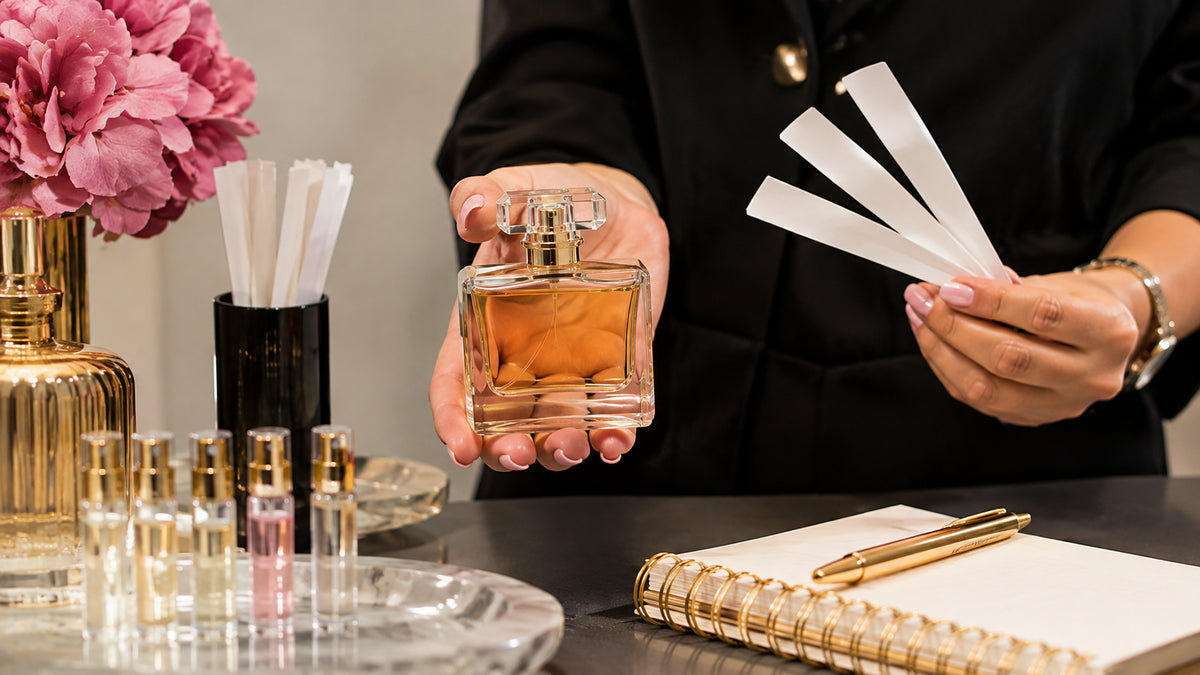
Present 3–4 fragrances on blotter strips based on your discovery conversation.
-
Let the customer smell each blotter and eliminate options.
-
Move 1–2 finalists to skin testing, spraying from 6–8 inches, 1–2 sprays.
-
Allow at least 10–15 minutes for dry-down; sampling is essential, and allowing scents to develop on skin is important.
-
Offer labeled take-home fragrance samples for high-intent clients, tied to a follow-up plan.
Managing nose fatigue: Offering coffee beans or water to smell can also cleanse your palate between fragrances. Your nose becomes desensitized when too many samples are sniffed in rapid succession. Allow time for your nose to rest between samples and keep the testing area tranquil and clutter-free. Sell multisensorially- music playing, textures, and how the bottle looks.
Storytelling, Brand Identity, and Brand Story
Building an authentic brand identity and story can increase conversion rates up to ten times in the perfume business. Selling fragrance is about telling a story about your product and letting your fragrance tell a story.
How to build narrative into every sale:
-
Anchor each scent to a moment or setting with a short storyline: “a summer evening in Santorini”, “inside a Paris cafe”, or “a 1950s New York jazz bar.”
-
Blend other products with your fragrances, like cookbooks and sensory objects. There has been a documented case showing that doing this caused 3× ROAS on launch.
-
Make sure your logo colors & style appear across luxurious packaging, websites, samples, and social media networks.
-
Channel your customer’s values with features like vegan formulas, fair-trade sourcing, refillable bottles, and locally-made batches.
Train your sales team to memorize 2–3 lines of your brand story for each hero perfume. Educate them to be able to recite these fun facts in less than half a minute during consultations/facial services or live streams; this will assist in retaining customers by branding.
Online vs. Offline Perfume Sales Techniques
Most perfume brands in 2026 need both channels working together. Online perfume sales reduce overhead costs significantly, while offline selling allows customers to test perfumes before buying. The key is creating a unified customer experience across both.
Optimizing Online Product Pages for Fragrance Sales
Your product page is your salesperson when selling online. Highlight key features like fragrance notes and longevity. Use sensory language to evoke emotions in descriptions.
Elements every product page needs:
-
Clear photos of the bottle and packaging, close-ups of textures (a good unboxing experience can leave a lasting impression)
-
Note breakdowns (top notes, heart, base notes) with concise descriptions using bullet points for clarity
-
Longevity expectations and usage suggestions (day/night, season)
-
Star ratings, written reviews, UGC photos or videos- user-generated content builds trust and acts as social proof
-
Cross-selling widgets ("You may also like" or "Similar perfumes with vanilla") to increase cart value
Search engine optimization is essential for increasing perfume brand visibility online. Make sure product pages target relevant search engine queries to drive organic traffic.
Offline Visual Merchandising and In-Store Experience
Creating an immersive shopping experience improves perceived value. Arrange fragrances by family or use-case rather than alphabetical order.
-
Build themed tables (e.g., "Summer 2026 Citrus Collection") with simple educational signage explaining the note structure.
-
Train staff to approach customers without pressure. Offer quick scent discovery quizzes or mini consultations. Exceptional customer service means reading the room, not reciting a script.
Digital Marketing Strategies That Drive Perfume Sales
Social media platforms are crucial for perfume marketing, with billions of users available to reach the right audience. Over 70% of customers discover fragrances online, making online marketing non-negotiable. Regular content posting increases brand visibility and engagement.
Key channels and their roles:
|
Channel |
Role |
Best For |
|
TikTok |
Discovery, viral reach |
Short-form "scent vibes," unboxing, application videos |
|
|
Visual storytelling |
Reels, high-quality visuals, lifestyle content |
|
|
Inspiration boards |
Gift guides, scent mood boards |
|
Google Search |
Intent capture |
SEO-driven blog posts, product pages |
|
|
Conversion, retention |
Funnels, loyalty, launch announcements |
Creative ad ideas can significantly increase perfume sales. Track ad spend and performance metrics (CPM, CPC, CPA, click-through rates) to optimize fragrance sales campaigns and stop wasting budget on low-intent audiences. Utilizing social media can enhance perfume brand visibility, and creative ad ideas can enhance engagement with paid ad campaigns on Google.
Influencer Marketing and Social Proof
Influencer marketing can effectively promote perfume products. A 2026 study from Seoul National University found influencer marketing had significantly larger sales elasticity than TV or online display ads alone.
-
Choose creators whose target audience matches your perfume market segment-niche fragrance reviewers on YouTube, lifestyle influencers on TikTok Shop. Instagram Reels and TikTok Shop enhance perfume sales directly.
-
Micro-influencers often outperform celebrities in engagement and perceived authenticity. Start with gifted free samples plus affiliate codes.
-
Campaign ideas: "scent wardrobe for the week," blind smell tests, and honest first impressions filmed on camera.
-
Using influencer marketing can significantly boost perfume sales when creators authentically align with your brand.
Content and Email Funnels for Fragrance Sales
Educational content and email marketing sequences convert curious readers into buyers, then into repeat customers.
-
Blog topics: "How to choose a signature scent in 2026," "Best office perfumes under $100"-interesting content that answers real questions while featuring specific products. These posts attract customers via organic traffic from search engines.
-
Email funnel structure: Welcome sequence → scent quiz results → targeted recommendations → new fragrance launch announcements → loyalty rewards.
-
Segment subscribers by previous purchases or quiz outcomes ("woody lovers") to tailor recommendations and increase open rates and click-through rates. Encourage customers to engage by offering value at every touchpoint.
Direct Sales, Events, and Pop-Ups
Direct sales settings-pop-up shops, in-home events, trunk shows-are powerful for perfume brands without permanent retail stores. Encouraging immediate decision-making through promotions drives purchases at these events.
-
Structure a small perfume event: Introduction to the brand story, guided scent discovery, sampling bar, closing offers (event-only bundles or discounts).
-
Use QR codes on displays to capture leads, connect guests to your online shop, and enroll them into email or SMS lists immediately.
-
Create limited-edition fragrance products or gift sets available only at specific events to tap into exclusivity and urgency. These unique selling points make events worth attending.
-
Follow up: Send thank-you emails, re-share event photos on social media, and offer a time-limited reorder incentive. Scent can evoke memories-remind attendees of the experience.
Upselling, Cross-Selling, and Building Customer Lifetime Value
Increase revenue per customer ethically by focusing on value and the customer experience rather than pressure.
-
Upsell: Offer a larger bottle size with a better unit price, or a premium extrait version once a customer loves a certain scent.
-
Cross-sell: Bundling perfumes with complementary products can increase sales-matching body lotions, shower gels, travel sprays, or home fragrances.
-
Loyalty programs: Points for purchases, birthday rewards, early access to launches. These significantly increase customer lifetime value.
-
Evaluate Purchasing Behaviors: Track repeat purchase cycles (typically every 4–8 months) and time email reminders accordingly. Consider price elasticity to gauge how sensitive your clients are to upsell offers.
Measuring and Optimizing Your Perfume Sales Techniques
Even the best techniques must be measured and refined. Tracking sales performance indicators helps evaluate strategy effectiveness.
Key metrics to monitor:
-
Conversion rate (in-store and online)
-
Average order value
-
Repeat purchase rate
-
Sample-to-purchase conversion
-
Influencer campaign ROAS
-
Cost per acquisition
Suggest simple in-store tracking methods: daily logs of which perfumes were sampled most vs. which were actually sold. A/B test online elements-different product photos, revised scent descriptions, alternative bundle offers, and varied ad creatives.
Sales staff training can significantly impact perfume sales success. Run regular team sessions using actual customer feedback and sales numbers to refine scripts, sampling flows, and merchandising. Continuously monitor current trends and market trends for pricing and assortment adjustments.
FAQ
How many perfume options should I present to a new customer at once?
Offer 3–4 scents that you think they might like based on the consumer's preferences. Narrow it down with blotter tests, then skin-test 1–2 finalists so you don't overwhelm them.
What is the best way to sell perfume online when customers can't smell it?
Appeal to other senses using rich descriptions, showcase products with high-quality photos, reference familiar fragrances, emotions, and moments, and provide inexpensive sampler sets so shoppers can purchase with confidence, eliminating return anxiety.
Are discount campaigns good or bad for a perfume brand?
Heavy discounting can erode value perception. Instead, use targeted/timed exclusive bundles, loyalty, or seasonal promotions thoughtfully with price elasticity in mind.
How important are fragrance samples in driving long-term perfume sales?
Samples drive new customer acquisition and full-bottle sales. There have been campaigns that have generated up to 40,000 sample requests in one day. Identify which samples convert to purchases to refine discovery kits and increase conversions.
Should small perfume brands invest in influencer marketing in 2026?
Absolutely. Test micro-influencers with audiences that fit your target market. Begin with product gifting and tracking codes, and then evaluate sales performance to determine which influencers are working and scale paid budgets accordingly.


