



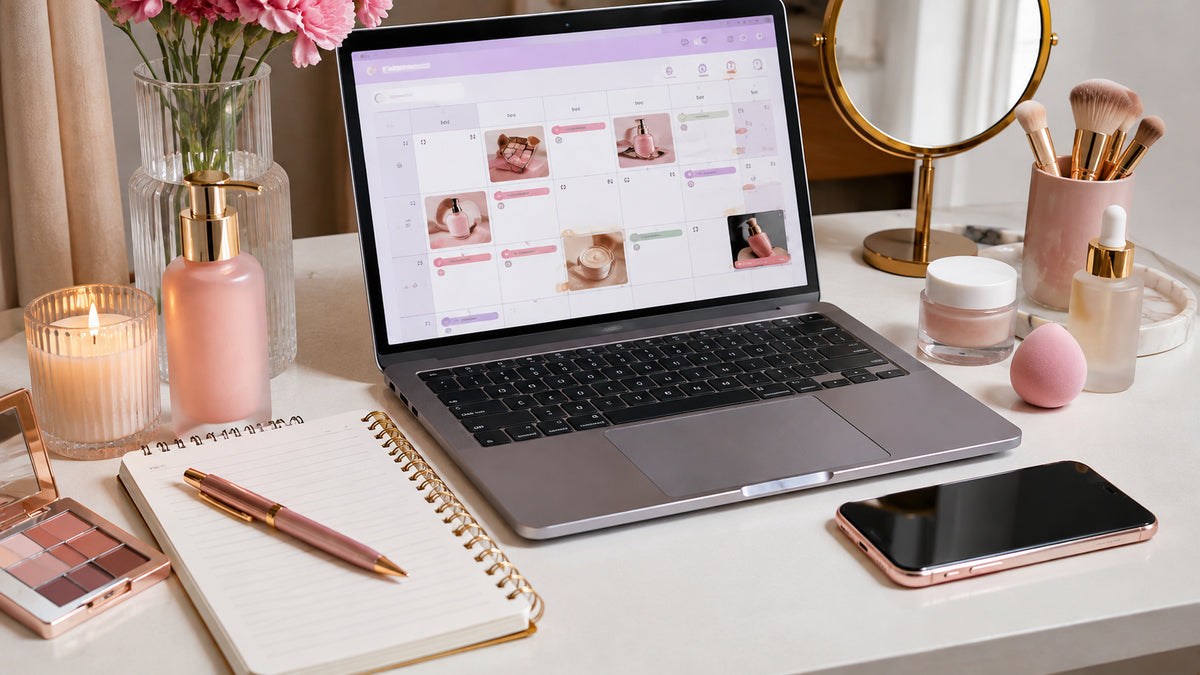
Starting a beauty brand is about more than killer formulas and sporadic Instagram posts. Thoughtful content marketing allows new beauty entrepreneurs to connect with their audience, foster trust, and guide potential customers through the buying process. This handbook will walk you through establishing your strategy and objectives, selecting the right marketing channels for your brand, creating valuable content, and building a realistic 90-day content calendar.
Why Do I Need to Develop a New Beauty Seller Content Plan In 2026?
The beauty industry is packed with competitors. From indie brands and influencer-backed companies to existing retailers, everyone is fighting for shoppers’ attention. As a new beauty seller, how do you differentiate yourself? Knowing your identity and creating content around your customers’ interests and needs will help.
Are you ready to launch your first skincare brand or grow beyond Etsy or Amazon to your own website? Whatever your goals are, your content marketing strategy should align with defined goals like awareness, email captures, first purchases, and repeat purchases.
Here’s a great starting point for gaining traction with your visibility goals and keeping your content marketing efforts actionable with this 90-day content plan.
Clarify Your Brand Foundation Before Creating Content
First, determine your brand’s niche, Unique selling proposition, and values before you start writing anything. The messaging for a sensitive skin skincare brand will differ from that of a vegan lipstick line or a textured hair care line.
Next, craft a one-sentence brand story that highlights what your brand does, what makes your products different, and why customers should purchase from you. Repeat this message everywhere: on your website, social media channels, and marketing materials.
When it comes to skincare and products with skin treatment claims, be sure your wording around ingredients and performance is factually correct. Don’t make vague claims like “Clinically proven” or “Doctor tested” unless you have proof.
Build Content Pillars That Fit Your Beauty Brand
Content pillars are 3–5 overarching themes that help structure your content strategy and keep content planning simple. Content pillars allow you to stay on-brand while offering your audience a familiar variety of content.
Here are examples for different beauty niches:
|
Niche |
Pillar 1 |
Pillar 2 |
Pillar 3 |
Pillar 4 |
|
Sensitive skincare |
Ingredient Science |
AM/PM Routines |
Community Stories |
Sustainability |
|
Vegan lipstick |
Color Inspiration |
Application Tutorials |
Vegan Ethics |
Creator/UGC Looks |
|
Textured hair |
Texture Education |
Styling Routines |
Before & After Results |
Community Voices |
Select pillars that make sense for your products, business goals, and team size. If you're a solo founder, start with 3 attainable pillars. As your team grows, think about diversifying your formats & channels.
Use your pillars as a source of ideas to build your social posts, newsletters, and blogs around. You won't always have to think of new content ideas from scratch.
Know Your Audience And Map The Customer Journey
Identifying your audience allows you to provide answers to questions buyers may have at each stage of the buying process.
Examine customer interests on TikTok and Instagram comments, Reddit forums, and product reviews on Amazon or Sephora. Search for patterns around common problems, buying incentives, and questions that are currently unanswered by competitors.
Using what you learned, create 2 to 3 buyer personas and pair each one with a stage of the customer journey outlined below.
-
Awareness: "Do I need a retinoid?" → educational Reels, explainer posts
-
Consideration: "Is this safe for sensitive skin?" → ingredient deep dives, comparison posts
-
Conversion: "How do I apply it?" → makeup tutorials, routine builders
-
Post-purchase: "How do I get the best results?" → Follow-up emails, personalized tips, and educational content that helps existing customers get the most from their products.
Combine these learnings with purchase histories from existing customers. You'll discover buying patterns and product affinities that allow you to offer personalized suggestions. Use these insights to craft relevant content for each stage of your buyers' journeys, from discovery through repeat purchase.
Design A Simple Multi-Channel Content Strategy
For a new beauty brand, it's better to concentrate on a couple of key social platforms than to spread yourself across all of them.
See to it that each channel you work with helps move your marketing goals forward.
|
Platform |
Best For |
Key Stat |
|
TikTok |
Discovery, virality, social commerce |
22% of consumers buy beauty directly via TikTok |
|
|
Visuals, community, Reels, carousels |
~1.63–1.85% engagement rate for beauty brands |
|
YouTube |
In-depth routines, reviews, SEO |
Strong for consideration-stage content |
|
|
Long-tail intent, aesthetic inspiration |
Evergreen discovery |
|
|
Retention, owned audience |
Not algorithm-dependent |
Consider what platforms your audience hangs out on and where you can consistently create content.
Take into consideration your purpose: If quick awareness is what your brand is after, putting your energy into TikTok and Instagram might be the way to go. If you sell high-value skincare products, you may want to leverage Instagram to educate your followers and pair that with blog content and email newsletters.
Expand your keyword research as your brand grows. Find out what beauty products/services your audience is searching for online, and what concerns they have and how they go about finding solutions. You should also produce website content that's been through a search engine optimization process(SEO). This helps people who are googling for products and solutions find your useful blog posts.
Plan Content Formats That Convert For Beauty Products
Consumers shopping for beauty products often want to know what they look like, feel like, and do before buying. Select content formats that show product features and provide answers to practical questions shoppers may have.
Try these content formats:
-
Makeup tutorials and GRWM videos: Demonstrate application techniques and everyday routines.
-
Ingredient breakdowns: Explain formulations, benefits, and appropriate product use.
-
Before-and-after comparisons: Show realistic results without misleading claims.
-
Swatch videos: Display shades across different skin tones and lighting conditions.
-
Texture close-ups: Highlight consistency, finish, and application.
-
New product recommendations: Recommend products that go well together, new releases, and beauty favorites that fit your customers' needs.
Start creating engaging content in two or three formats that you know you can make consistently, and modify those to fit each platform. Add a call to action that relates to your content, such as “Shop Now”, “Save This Routine”, or “Browse Our Shades”.
Use interactive content formats like polls, quizzes, and Q&A sessions to boost engagement and learn more about your customers.
You do not need professional cameras to start creating content. Shooting with your phone, good lighting (natural lighting is great), plain backgrounds, and clear audio will do the trick. Include closed captions, readable text, and image descriptions to increase accessibility.
Create Educational Content That Builds Trust
Informational blog posts allow beauty brands to answer questions your customers may have and show you that you know your stuff, without being blatantly promotional.
Topics can include:
-
"Retinol for Beginners in 2026"
-
"How to Layer Vitamin C and Niacinamide Without Irritation"
-
"Heat-Protectant 101 for Coily Hair"
-
"Clean Beauty: Debunking the Marketing Claims"
Convert common questions into a blog series. Like “Ingredient Sunday” or “Clinic your Routine.” This ensures you always have content ideas and you’re answering questions your customers really have.
Use simple language and explain with science when you talk about ingredients, sensitivities, and safe products. Add proper patch-testing advice or suggest they see a dermatologist if applicable.
Pull out helpful educational copy and turn it into blog posts, email newsletters, and website FAQs.
Use Social Proof, Beauty Influencers, And UGC Strategically
Consumer reviews, testimonials, and user-generated content (UGC) help shoppers evaluate unfamiliar beauty products through real customer experiences, building trust and strengthening brand loyalty over time. 99% of beauty shoppers read ratings and reviews online.
You don't need to collaborate with mega-influencers to have success through influencer marketing.
Micro-influencers can allow smaller brands on a tight budget to reach target audiences. Send your products to 5–10 content creators you feel have content, followers, and values that align with your brand.
Promote honest content creation by offering:
-
First-impression and unboxing videos.
-
Customer tutorials and product demonstrations.
-
Branded hashtag campaigns.
-
Discount codes for customers who share their looks.
Evaluate creators by how well they connect with your audience, the quality of their engagement, and the authenticity of their content, not simply by their follower numbers.
With consent, repurpose customer and creator content on product pages, social channels, and ads. Be transparent about sponsored or incentivized partnerships when necessary.
Build A Practical 90-Day Content Calendar
Breaking your content calendar into 90-day chunks lets you turn your marketing activities into goals you can realistically hit. Everything from building brand awareness with your audience to converting them into customers.
|
Phase |
Focus |
Example Content |
|
Month 1 |
Brand introduction, education |
Hero product launches, ingredient explainers, brand story posts |
|
Month 2 |
Social proof, tutorials |
Before/after content, influencer UGC, routine videos |
|
Month 3 |
Promotions, deeper education |
Launch offers, bundles, community highlights, scaling ads on best performers |
Begin by planning 3–4 posts for your social media platforms per week across your 1–2 main platforms. Remember, you can repurpose the same content across platforms when applicable. Start an email newsletter with 1–2 emails per week as well. You can adjust how frequently you publish based on resource availability and audience feedback.
Use a spreadsheet like Google Sheets or Notion to plan your posts by date, channel, content pillar, format, topic, hook, and call-to-action.
Leave room for series you’ll post regularly, as well as open slots to take advantage of beauty trends or your customers’ questions. Have a schedule you can refer to, but don’t let it limit you from going with the flow when necessary.
Measure Performance And Refine Your Content Plan
Focus on performance metrics that align with your marketing goals instead of vanity metrics like views or followers.
-
Awareness: Saves, shares, reach on educational content
-
Consideration: Click-through to product pages, email sign-ups
-
Conversion: First-time orders, conversion rate from content
-
Retention: Repeat purchases, customer lifetime value
Look at your analytics every month to see what pillars, formats, and topics are driving value.
Tweak underperforming content, test out new ideas, and expand on the things that are getting results. Track your marketing campaigns with UTM parameters and trackable links to attribute website traffic and sales.
5 Mistakes New Beauty Sellers Make With Their Content
Watch out for these mistakes when putting your beauty content marketing strategy into action:
-
Copying established brands: Focus on authentic messaging and product demonstrations instead of expensive production styles.
-
Posting only product photos: Include tutorials, routines, swatches, and relevant educational content.
-
Ignoring audience interactions: Respond to comments, questions, and direct messages to strengthen customer relationships.
-
Following every trend: Choose trends that support your brand identity and content pillars.
-
Neglecting owned channels: Build your email list and website content alongside your social media presence to reduce dependence on platform algorithms.
FAQ
How much content should a new beauty brand publish each week?
Begin by sharing 3–4 posts per week on 1–2 social channels and sending out a newsletter every 1–2 weeks. Publishing steady content that followers care about for 3–6 months will have a greater impact than overposting daily and exhausting yourself.
Do I need professional photography and video to launch?
Not at first. Remember: Content shot on your smartphone with natural lighting can look fantastic. Ensure you have clean audio, correct colors, and authentic visuals before worrying about fancy production.
When should I start investing in paid ads for my beauty products?
Allow 4–8 weeks to test out your organic content. Identify your top-performing posts and ask for reviews and UGC. When you’re ready to start the ads, begin with small budgets and work your way up.
How can a new beauty brand stand out against established beauty brands?
Find a niche, create value with educational content, and don’t be afraid to tell your story as a brand. Also: Connect with your followers by offering customized service through comments, DMs, and email replies.


